City Oasis


City Oasis opens up the garden of art centre Marres (Maastricht) to the public.
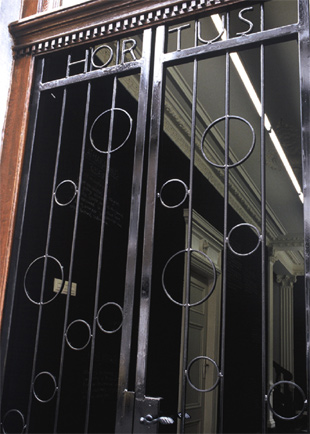
City Oasis re-arranges the spatial functions of Marres, closes what is opened and opens to what seems closed. The central corridor leading through the Marres building is disconnected from the rest of the house, and two transparent iron gates replace the back- and front doors. This corridor gives public access to the enclosed city garden, reveiling a wild oasis, with 'sitting islands' and an herbal garden. Seemingly everyday plants are grown here, but a closer look exposes their unexpected hallucinogenic effects.
While the Situationists were practicing 'the useless', introducing notions of play and dream in culture - underlining the importance of adventure as a direct experience - today exactly the useless and the adventurous (wandering, leisure, drifting) have become forms of planned entertainment. Wandering and drifting is located to different environments like commercial shopping malls and rock festivals. Doing nothing is no longer subversive, because it is no longer useless; instead, it is discovered as an economic factor of enormous importance.
City Oasis activates the notion of 'reclaiming space', a regular feature in the oeuvre of Bik van der Pol. By a simple architectural gesture, they articulate the connection between the street and the garden. It is about time to reconsider the outstanding features of the everyday. There is a lot of subversion to be discovered within the familiar.
City Oasis re-arranges the spatial functions of Marres, closes what is opened and opens to what seems closed. The central corridor leading through the Marres building is disconnected from the rest of the house, and two transparent iron gates replace the back- and front doors. This corridor gives public access to the enclosed city garden, reveiling a wild oasis, with 'sitting islands' and an herbal garden. Seemingly everyday plants are grown here, but a closer look exposes their unexpected hallucinogenic effects.
While the Situationists were practicing 'the useless', introducing notions of play and dream in culture - underlining the importance of adventure as a direct experience - today exactly the useless and the adventurous (wandering, leisure, drifting) have become forms of planned entertainment. Wandering and drifting is located to different environments like commercial shopping malls and rock festivals. Doing nothing is no longer subversive, because it is no longer useless; instead, it is discovered as an economic factor of enormous importance.
City Oasis activates the notion of 'reclaiming space', a regular feature in the oeuvre of Bik van der Pol. By a simple architectural gesture, they articulate the connection between the street and the garden. It is about time to reconsider the outstanding features of the everyday. There is a lot of subversion to be discovered within the familiar.