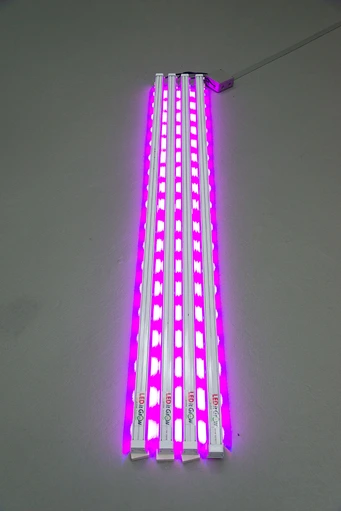
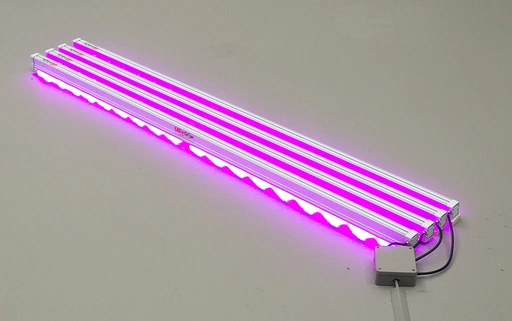
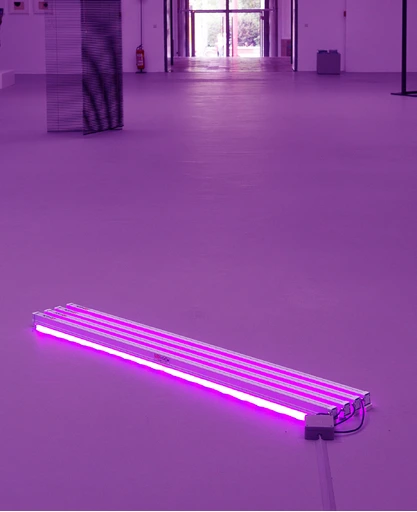
"How does the straight line feel?" It feels, as I suppose it looks, straight—a dull thought drawn out endlessly. Eloquence to the touch resides not in straight lines, but in unstraight lines, or in many curved and straight lines together. They appear and disappear, are now deep, now shallow, now broken off or lengthened or swelling. They rise and sink beneath my fingers, they are full of sudden starts and pauses, and their variety is inexhaustible and wonderful."
The title of this work, quoted from The World I Live In by Helen Keller points to spaces of imagination that often fall outside the contemporary psyche. Engulfed as we are in the present, we easily loose sight of the past and our connections with the future become blurred or seem out of reach.
The world is going through a period of unprecedented change and uncertainty, and continues to shift in ways we cannot fully comprehend. This contemporary moment is trapped in the straitjacket of the present while the media, social media and consumer culture dull our imagination. Human experiences fade, whilst technological applications seem to occupy and take over decision-making processes. At a moment when the value of culture and historical debate is instrumentalised by a perpetual present-ism, how can the creation of spaces of experience be used to re-orient the course of the debate?
How does a straight line feel?
How does the straight line feel? brings together the surface of painting (see the roundtable conversation in Artforum Summer 2015 on the Harvard paintings of Mark Rothko ), the three-dimensionality of light (what would Dan Flavin do today?), and the transition to LED-lit environments (see University Wageningen and Bright Box.
LED-light conditions human visual perception, and has effects on plants and animals. We are influenced by it through personal devices (like smart phones and tablets), while we are subjected to it in public or semi-public environments such as schools, hospitals, and other spaces. LED is rapidly replacing the orange light of our urban nightscapes and the warm yellow light in domestic space. LED lighting in the greenhouse horticulture sector generates rapid innovations like high-precision control of the growing process and huge energy saving.
The future light already arrived as the hidden quality of abstraction. As an extension from a modernist past directed by flows of information and energy, lines of light form new horizons, create new imaginative possibilities, and ways of occupying and experiencing space.